
Historical Authenticity Scale
I have been part of the historical reenactment world for nearly a decade and a half.
That is why...
a long time ago I felt the need to be able to manage authenticity according to some kind of system. It's so "easy" to say something is authentic or fantasy. Our little shop has now given us the opportunity to develop such a system in a simplified way. We have talked to about 50 experts about this by now. We compared and brainstormed. Here is its first appearance. If you have anything to add, write or call.
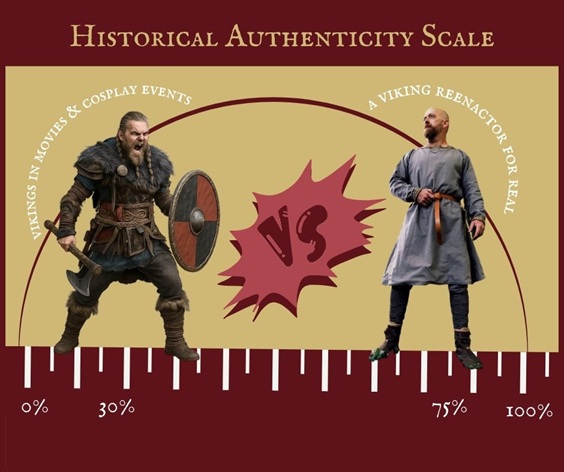
HISTORICAL AUTHENTICITY SCALE (0–100%)
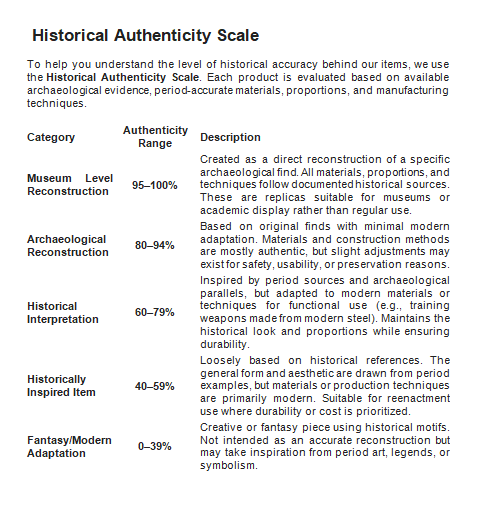
In the world of historical reconstruction and living history, every object exists somewhere along the spectrum of authenticity. This scale shows how faithfully a piece follows the materials, forms, and manufacturing traditions of its period.
A value of 100% is reserved for the original artifacts preserved in museums – all other items represent varying degrees of approximation toward that ideal.
95–100% — Museum-Level Authenticity
This category includes full reconstructions of specific archaeological finds. Every detail — material, proportion, form, and technology — is based on documented sources and created using the same historical methods. For example: iron smelted from bloomery ore, forged by hand, with hand-applied decorations copied directly from artifact photos.
Such items are not merely functional tools but hold scientific value as experimental archaeological reconstructions.
80–94% — Archaeological Reconstruction
Historically accurate replicas that follow period-appropriate shapes, proportions, and decoration, though they may include minor modern adjustments in materials or techniques. Example: a sword forged from modern spring steel that perfectly matches a 10th-century find in shape, but uses a contemporary alloy for greater durability.
These items are functional, authentic reconstructions — tools for experiencing and continuing historical tradition.
60–79% — Historical Interpretation
Objects reconstructed through interpretation and comparison of multiple sources. They do not copy a single specific artifact but combine features and stylistic elements from several finds. Typically, proportions and design remain period-correct, while the material or production method is modern. Example: a Viking sword made from modern steel with historically accurate hilt geometry.
This category aims to preserve the spirit and aesthetic of the past rather than achieve scientific precision.
40–59% — Style-Based Recreation
Historically inspired objects made primarily with modern tools and materials. Their shapes and decorations evoke the past, but proportions, structure, and composition are adapted to modern needs. Examples include a “medieval-style” garment made from contemporary fabrics, or a Viking-patterned belt sewn by machine.
These pieces focus on historical atmosphere and visual experience rather than exact reconstruction.
0–39% — Modern or Fantasy Creation
Creative interpretations freely inspired by history. These objects are not historically accurate but often striking in aesthetic or symbolism. Made from modern materials and techniques, their goal is artistic re-creation rather than reconstruction —such as decorative pieces, cosplay props, or stage and film accessories.
This category celebrates the artistic reinterpretation of the past.
*
EVALUATION CRITERIA
The authenticity percentage is not an absolute measure but the result of professional assessment, reflecting the weighted balance of the following key aspects:
- Material authenticity use of historically accurate materials (e.g. iron, linen, bronze) = +30%
- Form and proportion fidelity accuracy of measurements, construction, tailoring, proportions = +25%
- Technique / manufacturing method handcrafting, period techniques, traditional workshop conditions = +25%
- Decoration and stylistic features ornamentation, surface finish, historical motifs = +10%
- Documentation / sources references, find identification, published evidence = +10%
The final percentage is not a mechanical score, but a transparent professional estimation that shows how closely a given item approaches the material reality of its historical period.
*
We have also created our scale for the historical reenactment community. Feel free to use it if you feel it will help you, and please cite us as the source. We wish you a wonderful adventure in whatever exciting corner of the past your journey takes you!